
Younger Americans are politically active, but may be less-informed
August 14, 2026
A surprising divide may exist between being politically active and being politically informed, according to a new study funded by the Pew-Knight Initiative.This divide becomes more noticeable when comparing younger and older generations of Americans, who are engaging with politics and news in different ways.
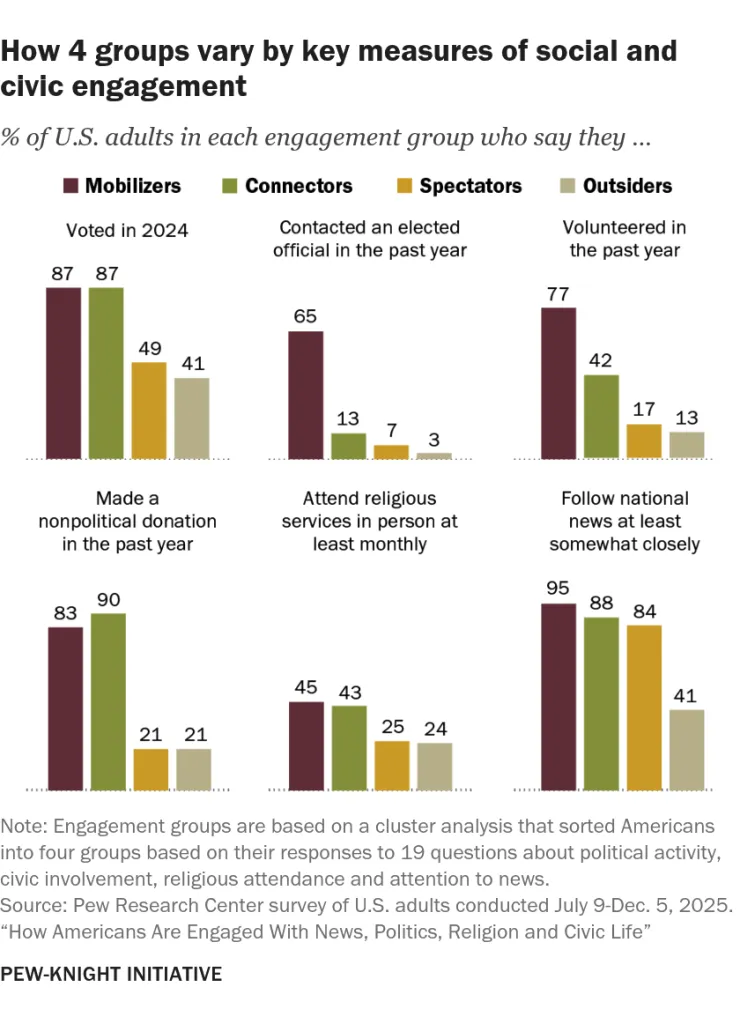
The study, which examined a range of behaviors among a representative sample of 5,939 U.S. adults, with additional data from 5,195 U.S. adults on the American Trends Panel. People were divided into groups:
- Mobilizers made up 9% of the population, and are the most civically active in politics community and religion;
- Connectors, at 28%, are engaged but less political;
- Spectators, 31%, follow the news but don't participate otherwise;
- Outsiders, the remaining 31%, participate at low levels across all categories.
A follow-up survey quizzed participants in all categories on basic political facts, such as who their current governor was and the definition of a tariff.
“These questions were kind of an overarching look at, you know, do you know who's in charge of the House? Do you know who's in charge of the Senate?” Senior Researcher Elisa Shearer said.
One of the most surprising results lay within the most politically engaged group, the mobilizers. Mobilizers over the age of 50 answered all questions correctly over 80% of the time, whereas mobilizers under the age of 30 answered all questions correctly only 49% of the time. This implied that being politically active didn’t necessarily correlate with being politically informed.
“It seems that younger folks are still less likely to answer those questions correctly,” Shearer said.
This is despite the fact that young mobilizers were found to volunteer, follow the news and participate in other forms of community engagement at the same rates as older mobilizers.
“Mobilizers tend to be a little more higher income and higher education, but in terms of demographics, they're about the same proportion of younger people and older people,” Shearer said. “But we still see that knowledge difference, right? So it means that engagement isn't the only thing that's explaining political knowledge [between older and younger participants].”
Confidence may be one factor that dictated the survey results. Barring outsiders, who almost neatly map onto the population as a whole, the largely younger group of spectators was the most likely group to answer "not sure" rather than guess incorrectly.
“I can't tell if secretly they know and they're afraid of telling me,” Shearer said. “But it also might be due to more higher education, or types of education…maybe generations have different types of knowledge.”
Another significant finding concerns how different generations engage with news. Spectators, the group with the largest proportion of young adults, were found to consume news privately and “observationally.” They typically like or share social media posts from news organizations within direct messages, instead of sharing publicly. Older adults, on the other hand, were more likely to consume news through more traditional avenues including TV, radio and print publications.
"It's almost like news is like the bottom line, the bare minimum, the gateway to politics," Shearer said. “Spectators are less likely than the other groups to be commenting [on politics] publicly…and almost half of young adults are in this group.”
Across all four engagement groups, 83% of older adults say they follow national news closely or somewhat closely, while only 64% of younger adults make the same claim. However, digital news engagement, such as viewing a social media post, may be harder to self-measure than a weekly newspaper subscription.
So younger adults aren't necessarily “checked out” of politics or the news, but may be engaging and learning in a different manner than older adults do.
—By Carolyn Neugarten
You can read more about how the survey was developed and how researchers measured engagement on the Pew Research Center’s site.