Where they are now: Meryl Kornfield
August 20, 2026
An occasional series on former IRW interns.
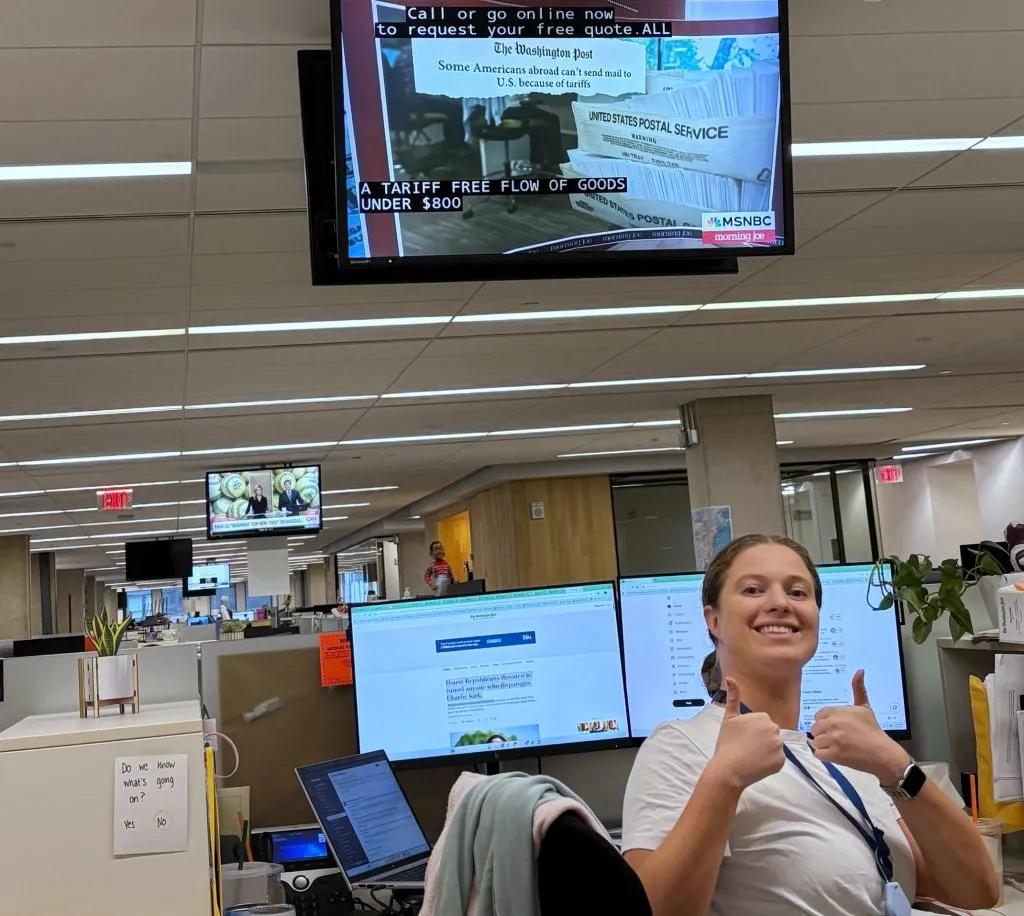
In The Washington Post building, there’s a new addition to the Pulitzer Prize wall: “Pulitzer 2026 for Public Service.” The award details the Post’s coverage of the Trump administration’s federal agency overhauls during the first months of his second term.
Investigative Reporting Workshop alumna and Post reporter Meryl Kornfield co-bylined five of the 15 articles included in the award-winning package. She was 28 years old, and it was her second time on a Pulitzer Prize-winning team.
She was also part of the team that won the 2025 Breaking News Reporting Pulitzer for coverage of the attempted assassination of Donald Trump when he was a candidate for president. Kornfield was at home watching Trump’s speech in Butler, Pennsylvania, on her computer when she heard the shots fired, and she worked on the story from Washington, D.C.
Finding a work-life balance hasn’t always been easy, and it was especially difficult while she was on the 2024 campaign trail. “It’s good to push yourself,” Kornfield said. “I'm really proud of all the effort I’ve put into stories.”
Kornfield checks platforms daily for information on her current beat covering federal agencies, keeping an eye out for story ideas. She previously worked at the Post on the investigations desk and as a general assignment reporter.
Her interest in journalism began in high school, and it deepened during her capstone class at the University of Florida, where she discovered investigative reporting. Ted Bridis, a former Associated Press Pulitzer Prize-winning investigative editor, taught the class, which led her to a project in the state capital examining aging registered sex offenders. Her work was published by the Associated Press, and she did a separate deep dive focused on South Florida for the Miami Herald.
She joined IRW as an intern in the summer of 2019. In a sit-down conversation in June, she touched on how important IRW was to her career at the Post. She opened with, “I wouldn’t be here if it wasn’t for the IRW.”
The Post enlisted several IRW interns to help with an investigation that summer into the opioid crisis. Kornfield seized the opportunity. She read as many documents as she could, gathering relevant information and pulling out story ideas for the project. She connected with senior reporters Scott Higham and Sari Horwitz, whom she referred to as her “Post parents.”
“It can be difficult, especially for young reporters. We really push ourselves because we have a lot to prove,” Kornfield said. “I also feel really fortunate that I worked with great people who encouraged me and told me to take time and celebrate wins.”
Her reporting portfolio already stands as an inspiration for future journalists, and she hopes to take her experiences into the classroom someday with a hands-on approach to investigative work.
She advised aspiring journalists to seek out coverage areas and beats, to “be the kind of reporter that you want to be and tell the stories that you want to tell.". She knows that “the best reporting will come when you’re excited about the story.”
—Profile by Elizabeth Rozeboom