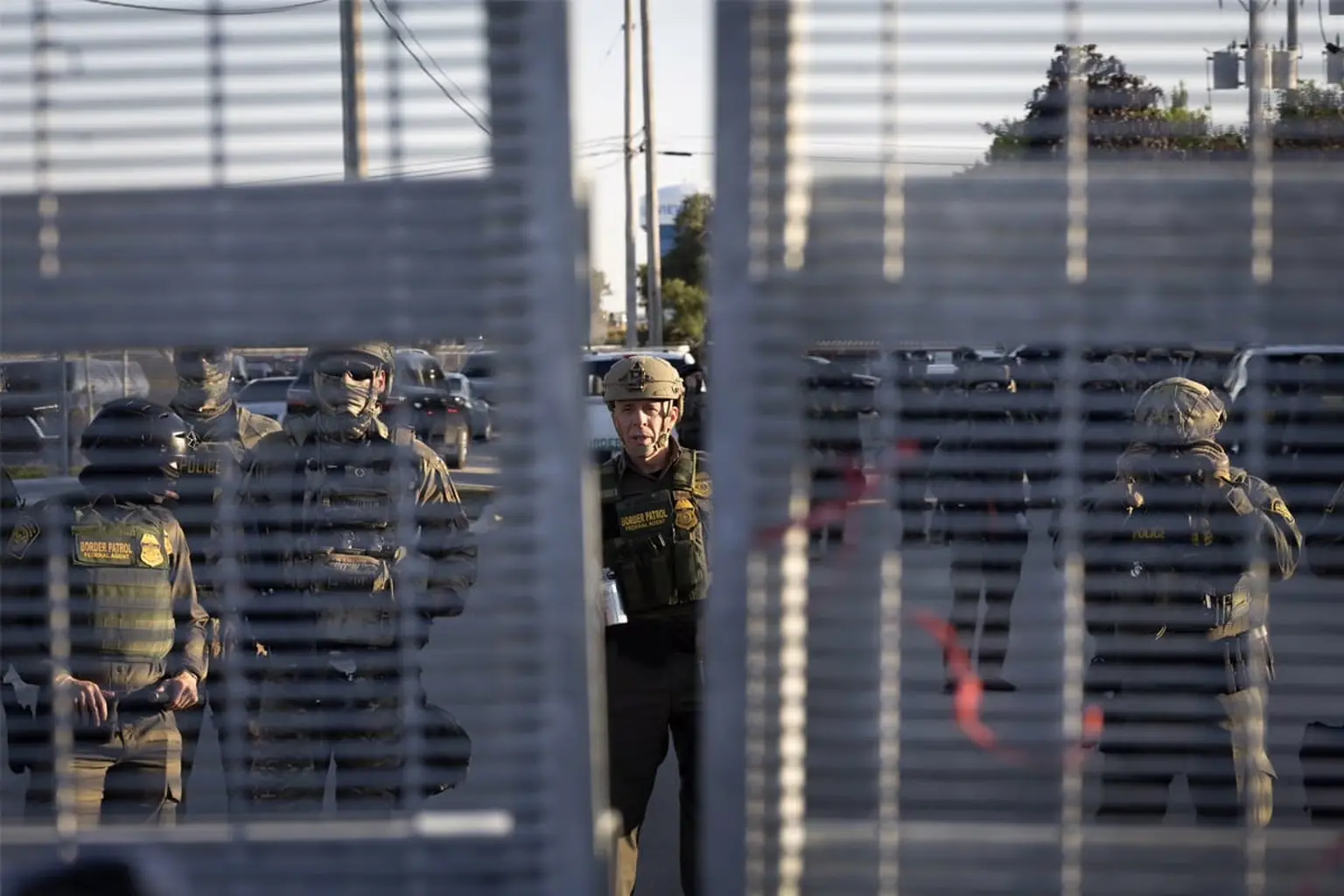
U.S. Border Patrol Commander Gregory Bovino, center, pictured with border patrol agents at an immigrant processing center in Broadview, Illinois, September 27, 2025. (Photo by Scott Olson/Getty Images)
Greg Bovino’s Border Patrol agents use disproportionate force, data shows
Border Patrol agents in the El Centro Sector have reported using force on other people more than three times as many times as they have faced assaults — a ratio higher than anywhere else in the agency — according to federal data.
January 1, 2026
A high-ranking and highly scrutinized Border Patrol official has presided over a disproportionate amount of use-of-force incidents, according to an analysis of federal data by the Project On Government Oversight (POGO) and American University’s Investigative Reporting Workshop (IRW).
Gregory Bovino, the chief of the Border Patrol’s El Centro Sector in California who has been in charge of the controversial Department of Homeland Security (DHS) raids in Chicago and Los Angeles, has been leading federal agents accused of excessive violence against migrants, protestors, journalists, and others in these operations. A federal judge just last week said these agents’ use of force in Chicago "shocks the conscience."
To justify their use of force, Bovino and other senior DHS leaders have cited assaults against federal law enforcement. It’s not a new argument for Bovino: He told congressional staffers in 2023 that "The use of force by agents when agents are assaulted does happen."
But federal data from the last four fiscal years shows that — under Bovino’s leadership — Border Patrol agents in the El Centro Sector have used force far more often than they’ve faced assault. For every assault they’ve faced, El Centro agents have used force over 3.6 times, according to the data. Across the Border Patrol, use of force incidents outpace assaults on agents by just over a 2-to-1 ratio. But El Centro’s data reflects the highest ratio of use of force to assault of any Border Patrol sector in the nation, far higher than the other 19 sectors and the Border Patrol overall.
The federal data covers fiscal years 2022 through 2025, which ended on September 30, 2025. The government last updated the data on October 15. Sector-by-sector use of force and assault data is not readily available prior to fiscal year 2022.
During those four years, there were 300 incidents of agents using force out of the El Centro Sector and 83 incidents of assaults against agents, according to agency data. Across the Border Patrol as a whole, the data shows around 2,900 use of force incidents and nearly 1,400 assault incidents.
Even compared to the sector with the second-highest ratio of use of force to assault incidents, El Centro stands out. The Tucson Sector in Arizona has a ratio 33% higher than that of the Border Patrol as a whole, about 2.76 use of force incidents per assault incident.

The same pattern holds when analyzing use of force and assaults by the number of Border Patrol agents involved instead of the number of incidents; however, that analysis shows El Centro deviating even more from the rest of the agency. The ratio of El Centro Sector agents using force versus being assaulted (4.16 to 1) is more than double the Border Patrol-wide ratio (1.95 to 1).
POGO and IRW analyzed data derived from the system used by Customs and Border Protection (CBP), the Border Patrol’s parent agency, for agents to report use of force and assaults.
If there’s an outsized number of use-of-force incidents being reported in a sleepy sector, that probably tells us a lot about the reigning organizational culture in that sector…
— Adam Isacson, the Washington Office on Latin America
This data sheds additional light on the track record of Bovino, whom DHS recently dubbed the Border Patrol’s "commander at large." This analysis also comes as recent reporting says the administration plans to replace Immigration and Customs Enforcement (ICE) officials with Border Patrol staff to further ramp up immigration arrests. Bovino has said, "we’re taking this show on the road to a city near you."
DHS and agency spokespersons, as well as Bovino and Daniel Parra, Bovino’s deputy in El Centro who has also played a leading role in the Chicago and Los Angeles operations, did not respond to requests for comment.
"Bleed alongside them"
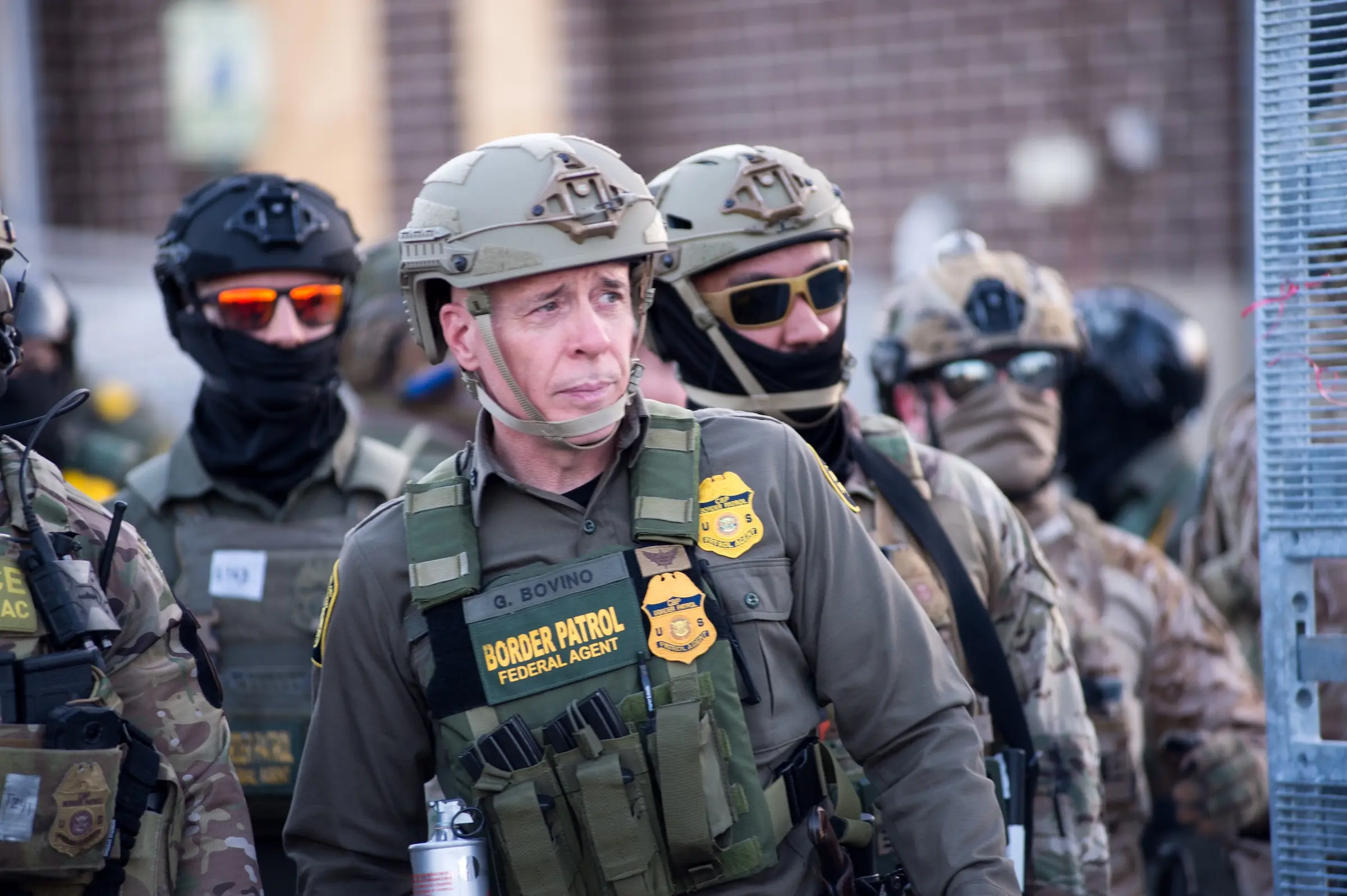
Bovino, who joined the Border Patrol in the 1990s, became chief of the El Centro Sector in April 2020. The sector stretches from a 70-mile section of the U.S.-Mexico border through Central California to the state’s border with Oregon. He has been in charge of that sector since then, except for a brief period in 2023.
Bovino has been one of the main faces of the Trump administration’s crackdown on immigrants. In Chicago and Los Angeles, he is often deployed on the ground with federal agents during operations. During a 2023 interview with congressional staffers, Bovino touted the "leadership by example from senior leadership in the El Centro Sector." Describing the relationship of senior leadership with agents, he said, "as the saying goes, bleed alongside them, if you can."
CBP policy allows for agents to use force when they fear that "violence" or "assault" could take place, or in other situations, such as when a person is trying to evade arrest or resisting an agent’s commands.
Bovino said during his 2023 congressional interview there are risks unique to agents in the El Centro Sector. He said smugglers and transnational criminal operations pose a threat to agents, and they encourage "the illegal aliens to assault agents, as well."
He noted that these threats "include assaulting agents with the river water itself, which is highly polluted."
Use of force by agents in response to assaults can be deadly, but the term also includes "less-lethal" actions. "Use of force" can include striking a person, such as kicking or punching, or using weapons like batons, tasers, guns, and pepper spray. It can involve agents using devices that immobilize moving vehicles and other tactics. Agency policy states that "the use of excessive force is unlawful and will not be tolerated."
According to the Department of Homeland Security, it is generally mandatory for its law enforcement agents to report both assaults on agents and agents’ use of force, with the exception of "physical tactics or techniques that do not deliver a kinetic impact, such as [an] arm hold."
"El Centro is an outlier"

An expert who reviewed the data from El Centro notes that it’s not just that the sector’s agents use of force outpaces assaults on agents. It also outpaces that of other sectors on the U.S.-Mexico border, when compared to the number of apprehensions. That measure — the number of reported use-of-force incidents per 100,000 apprehensions — shows that "El Centro is an outlier," emailed researcher Adam Isacson, the director for defense oversight at the non-profit Washington Office on Latin America. Overall, he wrote, "No other sector *comes close* to El Centro in use-of-force incidents per apprehensions" (emphasis in original).
In fiscal year 2025, there were 410 use-of-force incidents per 100,000 apprehensions in El Centro — compared to 302 in the Laredo Sector, the next highest, according to Isacson, who analyzed this federal data after IRW and POGO reached out to him.
Isacson emailed that "In 2024 [the gap between El Centro and other sectors] was even more stark: 349 incidents per 100K apprehensions, the second-place sector, Big Bend, was 122." Isacson found that El Centro also reported the most use-of-force incidents per 100,000 apprehensions in fiscal years 2022 and 2023.
"'Migrant apprehensions' are a good measure of how busy a sector is overall," said Isacson, who tracks accusations of Border Patrol misconduct. "If there’s an outsized number of use-of-force incidents being reported in a sleepy sector, that probably tells us a lot about the reigning organizational culture in that sector, how quick they are to escalate, and what kind of behavior agents get rewarded for."
Of the nine Border Patrol sectors on the U.S.-Mexico border, El Centro ranks among the lowest when it comes to migrant apprehensions over the last four fiscal years, with significantly fewer than 100,000 apprehensions in each of those years unlike busier sectors that often have had significantly more.
| Border Patrol Sector | Incidents of agent use of force | Incidents of assaults against agents |
|---|---|---|
| Tucson Sector | 670 | 243 |
| El Paso Sector | 533 | 289 |
| San Diego Sector | 521 | 201 |
| El Centro Sector | 300 | 83 |
| Rio Grande Valley Sector | 248 | 180 |
| Del Rio Sector | 194 | 96 |
| Laredo Sector | 172 | 99 |
| Yuma Sector | 135 | 101 |
| Big Bend Sector | 34 | 21 |
| Swanton Sector | 13 | 22 |
| Detroit Sector | 10 | 12 |
| Special Operations Group | 10 | 6 |
| New Orleans Sector | 8 | 8 |
| Spokane Sector | 8 | 3 |
| Blaine Sector | 7 | 4 |
| Miami Sector | 7 | 9 |
| Buffalo Sector | 4 | 5 |
| Grand Forks Sector | 4 | 3 |
| Houlton Sector | 4 | 7 |
| Havre Sector | 2 | 0 |
| Ramey Sector | 2 | 4 |
Several El Centro agents’ use of force gained headlines during Bovino’s leadership in the sector. In the daylight on July 11, 2022, at least one Border Patrol agent fired around six shots into the driver’s and front sides of a minivan going down Highway 98, the Imperial Valley Weekly reported. The agent injured at least one person, according to the Weekly, and a Facebook photo published by the Calexico Chronicle shows the bullet-stricken van butted up against a tractor-trailer.
In a statement to the Weekly, a CBP spokesperson said the agent had attempted to stop the vehicle and that the driver failed to yield. CBP’s use of force policy reserves deadly force (including discharging a weapon) for times when an agent believes that a person poses an imminent danger of serious injury or death to themselves or another person.
Another case that year brought allegations of both a use of force and an assault on an agent. According to a letter from the American Civil Liberties Union (ACLU), a Border Patrol agent in the El Centro Sector allegedly "violently assaulted" a migrant woman who had fled violence in El Salvador with three children and was seeking asylum. Border Patrol agents apprehended them near a train station in Calipatria, California, on February 14, 2022.
The woman claimed an agent punched her in the mouth, hit her stomach, and slammed her against a train. The agent claimed the woman assaulted him.
Federal prosecutors filed criminal charges against the woman and her then-18-year-old son, but according to the ACLU, months later the charges were "dismissed at the federal government’s request." Federal agencies have previously declined to comment on the case.
"Turn and burn"
Data on reported apprehensions, use of force, and assaults in El Centro also revealed a shift in the last fiscal year: Agents are now reporting significantly more assaults than agents in other sectors. Isacson ran the numbers on reported assaults per apprehensions and found that El Centro’s numbers were in line with other sectors — until fiscal year 2025.
"Measured as a proportion of migrant apprehensions, reported assaults in El Centro are not unusual until 2025, when the El Centro Sector rises to double the rate of the second-place sector," Isacson wrote.
"This does raise eyebrows since Bovino has been so quick to allege ‘assault’ in Los Angeles and Chicago, even in dubious cases where the supposed assailants are released without charges."
Bovino took on a prominent role in the Trump administration’s "Operation At Large" in Los Angeles, which was accompanied by the National Guard and other law enforcement agencies. In September, he told press that federal agents would "turn and burn" until there are no immigrants left to target in that city.
The Los Angeles operation has been controversial both for the aggressive tactics used by agents and for accusations of stopping people on the basis of race. Federal agents’ use of force in and around Los Angeles has prompted criticisms from defense attorneys, Angelenos, experts, and advocates. The incidents include using explosive charges to blow down the front door on a home with children ages 1 and 6 inside when the person targeted was not present, and violently arresting a U.S. citizen filming masked federal agents smashing a window to forcibly remove someone out of a vehicle.
In the course of the operation, federal officials have also at times made false public statements about the threats they faced or shared claims in court that were either unsupported or contradicted by evidence. In one example, the Department of Homeland Security inaccurately claimed in a written online post that a U.S. citizen was "arrested because they ASSAULTED U.S. Border Patrol Agents." Another such case involved Bovino as the only Border Patrol agent testifying that he witnessed another agent getting hit in the chest in Los Angeles in June. No video clearly evidenced Bovino’s claim, but video did show that other agent shoving the protester, who himself had been charged with a misdemeanor for assault and was later found not guilty.
In Chicago, where he has led "Operation Midway Blitz," Bovino has faced pushback from media groups, journalists, and residents over his direction of federal agents and their use of force in response to protests. Plaintiffs in a court filing said Bovino has encouraged agents to use tear gas and pepper balls. They allege he personally threw tear gas "without justification" in a filmed incident.
Bovino posted a video to Facebook on October 13 depicting agents using force against protesters with the hashtags #Chicago and #OpMidwayBlitz. The clips, edited into a montage with action-movie-style music, depict agents tackling, pushing, and holding protestors to the ground. The caption suggests the use of force is justified because the agents are under threat of assault.
"Interfering with our agents or operations will lead to consequences," Bovino wrote in the post’s caption. "We support the right to protest, but public and agent safety is non-negotiable. Zero tolerance. The mission continues."
In several high-profile incidents, allegations of improper use of force have been met with claims that agents were responding to assault. In one instance in Chicago, an agent allegedly rammed his SUV into a car then shot a woman five times after yelling "do something, b–tch." DHS has publicly stated that instead "Border Patrol law enforcement officers were ambushed by domestic terrorists that rammed federal agents with their vehicles." The Justice Department is prosecuting the woman and another person, accusing them of "forcibly assaulting, impeding, and interfering with a federal law enforcement officer." Defense attorneys for the woman have accused the agent who shot her of destroying evidence, with prosecutors acknowledging that a CBP mechanic repaired the SUV and removed scuff marks.
A federal judge in Chicago has questioned agents’ tactics under Bovino’s leadership. On October 9, District Judge Sara Ellis temporarily ruled that federal agents could not use tear gas, pepper spray, or other weapons against journalists and protestors “who are not posing an immediate threat” after the media groups brought their complaint. Agents defied the order, using riot-control weapons on civilians at an October 25 Halloween Parade in Chicago’s Old Irving Park neighborhood, Ellis said in a court hearing.
In a November 4 deposition, Bovino said up through that date in Chicago “all uses of force that I’ve seen and all arrests that I’ve seen have been more than exemplary,” meaning agents used “the least amount of force necessary to accomplish the mission.” He said there have been “a whole myriad of violent actions that I see against law enforcement officers conducting a lawful law enforcement mission.”
Two days later, on November 6, Judge Ellis issued another order restricting use of force by federal agents under Bovino’s command. “I see little reason for the use of force that the federal agents are currently using,” Ellis said. “I don’t find defendants’ version of events credible.”
DHS said it plans to appeal Ellis’s order.
Published with The Project on Government Oversight

IRW has worked closely with the team at POGO since mid-2025 to produce in-depth journalism.