Inside one of the Border Patrol’s most violent sectors
Texts and records reveal how Border Patrol agents in southern Arizona privately talk about use of force and accountability — and how to avoid discipline.
January 1, 2026
Note: The following investigation includes details of violent and sometimes deadly encounters with law enforcement.
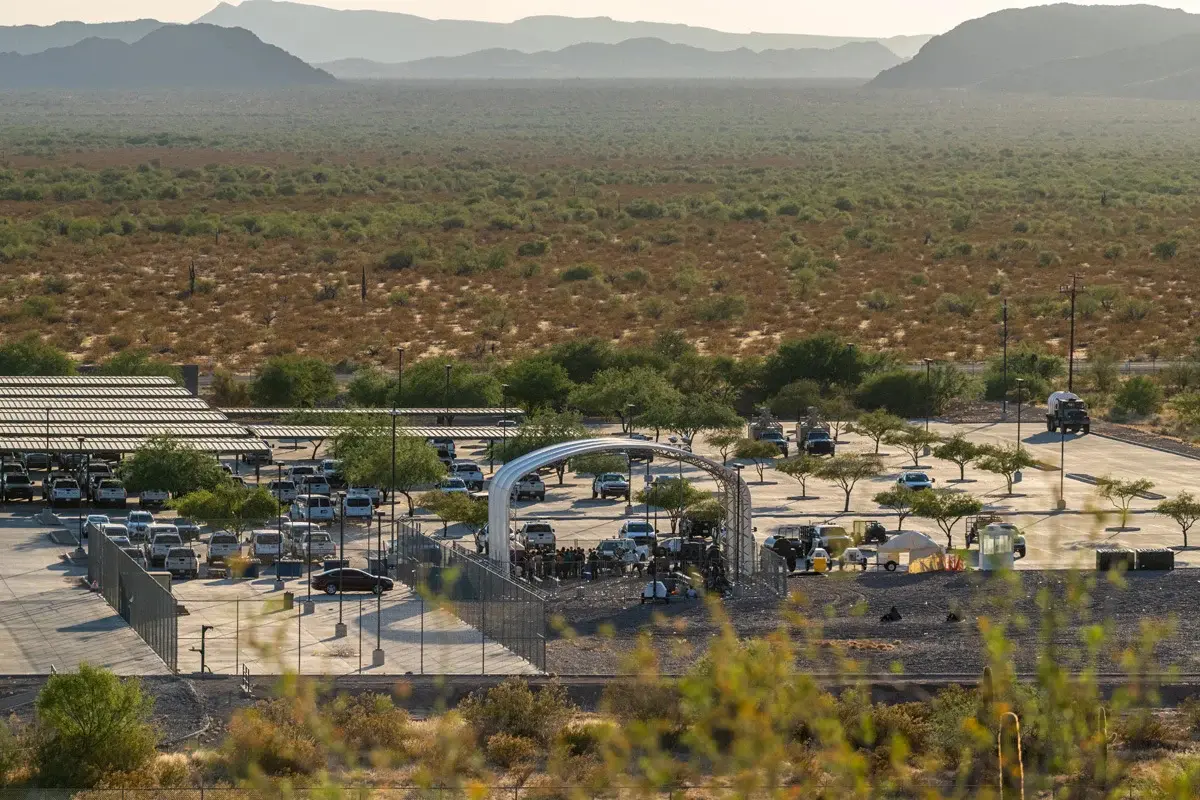
About 30 miles north of the U.S.-Mexico Border, the U.S. Border Patrol’s Ajo Station sits between the Tohono O’odham Nation reservation and a bleak desert area known as the Growler Valley. Due to the dangers presented by the rugged terrain and high temperatures, this Arizona station is often crowded with people who have crossed the border illegally, some of whom have voluntarily turned themselves in to the Border Patrol. Border Patrol Reddit threads suggest it’s not necessarily considered a desirable station for agents, often commuting hours to and from work every day. However, some agents believe that due to the remoteness of this station, it can be a good place to gain experience quickly, such as with tracking in the desert, seizing drugs, and processing people, to fast-track a career at the Border Patrol, a part of Customs and Border Protection (CBP).
Indeed, the current chief of the Border Patrol, Mike Banks, was acting patrol agent in charge at the Ajo Station about a decade ago. The current deputy chief patrol agent of the El Centro Sector, Daniel Parra, who has been instrumental in CBP operations in Los Angeles and Chicago over the last year, also was a deputy agent in charge of operations at the Ajo Station at one point in his career.
Ajo Station is part of the Tucson Sector, one of the most violent sectors in the agency. While the Border Patrol claims that assaults from migrants are a frequent and exceptional danger to its officers, the Project On Government Oversight’s (POGO) analysis of agency incident data over the last four fiscal years shows there are about twice as many use-of-force incidents as there are assaults.
Tucson Sector agents have used force in proportion to assaults on agents at a 33% higher rate than the Border Patrol average, and at the second highest rate of all 20 Border Patrol sectors. (The highest is the El Centro Sector, where Parra is second in command to Greg Bovino, who has been in charge of CBP operations in Los Angeles and Chicago over the last year.)
The Ajo Station made national headlines in 2023 when agents shot and killed Raymond Mattia, both a U.S. citizen and a citizen of the Tohono O’odham Nation. It’s unclear if those agents have been disciplined internally. Only a few months earlier, an incident happened inside a holding cell in Ajo Station, caught on camera, seen by witnesses, and resulting in a man needing medical attention. When faced with the possibility of criminal charges, the agent chose to resign less than two years after the incident.
These two incidents — one widely reported, in the field, and still being litigated, the other never reported by the media, inside a Border Patrol facility, and resulting in disciplinary action — offer insights about the state of accountability and the culture around it within the agency.
At a moment when CBP is conducting high-profile operations in cities across the country, new documents and data, obtained by POGO through a Freedom of Information Act lawsuit and examined alongside American University’s Investigative Reporting Workshop, shed light on an agency where agents are rarely held accountable for violent tactics in the field.
Records detailing an investigated use-of-force incident — including text messages and interviews with multiple Border Patrol agents — offer a window into how some Border Patrol agents discuss use of force in one of the agency’s most violent sectors, and accountability when agents are accused of going too far.
Agents’ text messages seemingly describe their view that it’s easier to justify violence outside the confines of government detention centers. Use of force incidents beyond the walls of a Border Patrol station can be situations more akin to the killing of Mattia months later in 2023, agents’ actions in U.S. cities over the last year like last week in Portland, Oregon, and numerous, often deadly instances involving migrants.
CBP acknowledged POGO’s questions sent in writing multiple times but did not provide any comment.
“Can’t let them run over us”
In the late afternoon of January 21, 2023, Border Patrol agent Jonathan Nathaniel Santiago was working a processing shift in the Ajo Station. “Processing” is where migrants who were traveling in the area and detained by Border Patrol are held as the agency determines where they need to be taken next. The people held in processing are rarely held by CBP for long periods of time, as opposed to ICE detention centers, where people can be held for years.
While seated at his desk, records indicate Santiago noticed a man from Mexico, whose name is redacted, standing next to the window of a crowded holding cell, near the cell’s door. According to a memo Santiago filed with his agency, he told the man to sit down twice — once with his hand and once in Spanish — after approaching the cell and opening the door. Santiago alleged that the man “laughed in his face.”
Santiago, an amateur Muay Thai fighter and 25 at the time, proceeded to physically “assault” the man by violently shoving him, according to investigative records. After the incident with Santiago, the man in the cell went to a camera and lifted “his shirt several times and touches his chest” where he said Santiago struck him. He was eventually taken to Banner University Medical Center South in Tucson and diagnosed with a chest wall contusion. Medical records indicate he “likely had a hairline rib fracture.”
The investigation into Santiago’s acts was led by CBP’s Office of Professional Responsibility (OPR), the agency’s internal affairs arm. OPR’s report of investigation includes numerous interviews with witnesses, text message exchanges from the days and weeks that followed, medical records, correspondence between a federal prosecutor and Santiago’s attorney, Santiago’s internet search history during and after his shift, and more.
CBP generally redacted Santiago’s name in 1,356 pages of records that CBP provided to POGO. However, his full name was unredacted once in those records, and his last name went unredacted elsewhere on four other occasions. Attempts by POGO to reach Santiago were unsuccessful.
One agent interviewed by OPR said they were “unaware of the existence of any established laws or policies that prohibit an individual from standing in a holding cell, if they are not creating a disturbance.” Another mentioned he didn’t “mind them standing at the windows because there is normally a lot of people in the cells.”
An agent who witnessed the incident told OPR that Santiago was “hot headed” and told Santiago to report the incident to his supervisor, and to “swallow your pride, you can’t be doing that here.”
During the Biden administration, CBP’s OPR expanded with hundreds of new hires amid a push for greater accountability. The expansion is brought up in the text exchanges between agents who also appear to be Border Patrol union stewards.
Critics of the Border Patrol have pointed to the National Border Patrol Council, the agency union that represents non-supervisory agents, as hindering accountability when it comes to use of force.
“Lot of new opr folks. Can’t let them run over us,” one agent texts the group. (All text messages are quoted as written, including misspellings and grammatical errors.)
A text message to Santiago reveals how one Border Patrol agent viewed the likelihood of serious discipline: “I think you’ll be good dude maybe a minor slap on the wrist or whatever.”
Records of Santiago’s internet search history suggest the agent may have lacked a full understanding of CBP’s use-of-force policies and questioned whether he had gone too far. At one point, he searched “is shoving someone use of force border patrol,” and “can you go hands on if someone insnt listening in law enforcement.”
The agency’s preferred way to refer to different types of “less-lethal” and deadly forms of violence is “use of force,” which can range from striking a person, to using weapons like tasers, pepper spray, and guns, to pursuing a car chase. CBP policy allows for agents to use force in situations when a person is trying to evade arrest, resisting an agent’s commands, or credibly threatening an agent, but also, the policy states that “the use of excessive force is unlawful and will not be tolerated.”
Critics of the Border Patrol have pointed to the National Border Patrol Council, the agency union that represents non-supervisory agents, as hindering accountability when it comes to use of force — and it has been involved in reducing discipline agents have faced. The union encourages agents to contact them when an incident happens and can be present during OPR interviews.
How the agency handled use of force “was problematic that entire time that I was with CBP.”
—Former Deputy Assistant Commissioner for CBP Internal Affairs James Wong
Art Del Cueto, a long-time and well-connected Tucson-based Border Patrol union leader with links to the Trump White House, has said accusations of excessive force often come without evidence and that “we’ve always held our agents accountable when they did something wrong.” According to Del Cueto’s LinkedIn, he patrolled on the Tohono O’odham reservation for the majority of his career, and was working for the union during both the Santiago and Mattia incidents. Neither Del Cueto nor other union officials responded to POGO’s requests for comment.
While names and phone numbers are generally redacted from the records, Santiago seemingly communicated with at least three union stewards in the hours and days after the incident, receiving feedback on his depiction of events. In a group chat of four agents that was recovered from one confirmed union steward’s phone, three indicate Santiago reached out to them, to which one agent replied in the chat, “how many stewards need calling?”
In the text exchanges among agents who POGO determined were likely union stewards, the agents seem to indicate a clear distinction between giving orders in processing versus out in the field.
The “reasonableness” standard
Santiago “failed to report the incident, until the detainee wished to file a complaint of excessive force,” CBP OPR records state.
Nonetheless, about two hours after the incident, Santiago sent an initial version of his narrative of what happened to the union stewards.
Santiago wrote in this early draft that, “I felt as if he did not respect my wishes and was testing me. He did not listen to me, so I did go physical and shoved him to sit down. ... I told him when I tell you to do something you got to listen. He then stood up very quickly and stated something about the cameras, but I decided not to deal with this individual and closed the door.”
In texts between what appears to be a group of Border Patrol union stewards discussing the incident, they acknowledge that the witnesses and cameras make proving the incident was a necessary use of force much harder. “[H]urt feelings dont justify using more force in processing,” the agent texts.
The agents agreed that “that memo needs…work” before Santiago officially filed it with the agency. Looming large over any use-of-force incident is its “reasonableness,” a standard created by a 1989 Supreme Court decision.
“Essentially all agents have to say is, ‘I feared for my life. I thought that they had a weapon. I thought that they would hurt someone else,’ and this allows them to meet that reasonableness standard,” said Irene Vega, a University of California, Irvine sociology professor who interviewed 60 Border Patrol agents and authored a paper on their use of force and this legal standard. “This creates this great sense of power, that they can basically justify almost any use of force.”
The Supreme Court wrote in 1989 that “officers are often forced to make split-second decisions” and that the standard cannot be based on “the 20/20 vision of hindsight.”
But with these subjective standards, it can be hard to pin down accountability. How the agency handled use of force “was problematic that entire time that I was with CBP,” former Deputy Assistant Commissioner for CBP Internal Affairs James Wong told POGO, referring to his interactions with CBP management. “We had different concepts of what use of force should be and the legal limits.”
“I saw where we would gather the facts, submit them to management for their review, and whatever action needed,” said Wong, who left CBP in 2011. “And that was when I quickly discovered that Border Patrol, in most incidents, determined that it was a good shooting or it was use of necessary force.”
With the help of at least one union steward, Santiago revised his narrative. The second version stressed the threat he allegedly faced.
“This was the first time while in the patrol that I felt uncomfortable with an individual,” Santiago wrote in his final memo.
Santiago, a self-proclaimed, avid Muay Thai fighter, added to this narrative that he felt threatened by the size and weight difference between him and the man.
“Even by his body posture I felt as if he could be a threat to myself.”
He removed the statement, “I decided not to deal with the individual” and added, “I decided to deescalate the situation and closed the door.”
“I do apologize for my actions, and I accept full accountability. I will learn from this encounter and will do better in the future,” Santiago wrote.
He submitted his final report three days later. But, in this case, with an injured man, witnesses, and strong documentation, Santiago faced consequences for his use of force.
“Due to an injury sustained by the detainee, the violation met the elements for felony prosecution,” the CBP OPR records state. However, the Justice Department agreed not to prosecute Santiago as long as he resigned and made “a promise that he would not seek law enforcement employment.” Santiago submitted his resignation on August 19, 2024.
“No cameras in the growler valley”
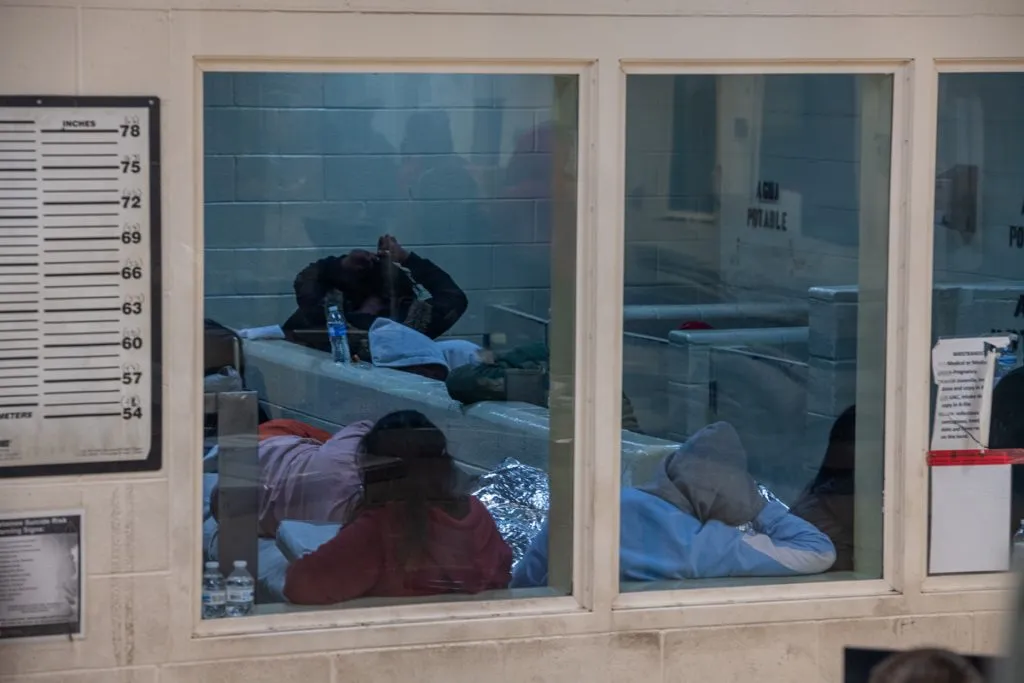
Records indicate that agents at Ajo Station draw a distinction between what happens within the walls of the processing center and what happens beyond them. Texts obtained by CBP’s OPR show Border Patrol agents talking about the case and about how Santiago’s actions could have been more easily justified if they occurred in the field, rather than in temporary custody in a Border Patrol detention facility with video cameras.
Lamenting that he couldn’t respond to the perceived disrespect of a CBP trainee by “beat[ing] his ass down,” one agent wrote, “It’s the same amount of disrespect I see from the aliens everytime I go into processing. It’s a joke.”
“But in the current environment and it being in processing wont help him,” one text reads. “If the alien puts hands on you, then u have justification, but pending that they will see him as the aggressor.”
In addition to general advice and guidance on how OPR involvement would proceed, one union steward also offered Santiago some advice about blowing off steam.
“Just lay low please,” he texted. “I find disappearing to camp works, no cameras in the growler valley.”
“Why would you go somewhere without cameras unless you’re planning on doing something that shouldn’t be recorded?” asked Mónica Ruiz House with the southern Arizona-based group No More Deaths, which aims to stop deaths of migrants in the deserts at the border.
The Growler Valley is an infamous stretch of the Ajo area, said House, who has spent time living in Ajo. The Growler Valley runs between the Growler Mountains and Granite Mountains near the southern border of Arizona, only accessible via dirt roads or on foot. It’s remote, rugged desert terrain that gets very hot with few water sources. Many migrants cross there, as do smugglers. Jason De León, an anthropologist at the University of California, Los Angeles, calls it part of “The Land of Open Graves,” and large numbers of human remains are routinely discovered there, including some deemed by medical examiners to have died from blunt force injuries and gun shots.
“Like Ik [I know] he’s in a cell but if he’s out in the field and he did the same shit he’s not listening so what’s the difference,” states one text whose sender is redacted but appears to be Santiago.
In response, another agent texts him back, “in the field there’s mitigating circumstances”… “Location, not listening to commands, potential for escape and assaults” … “No or little back up.”
But there’s less gray area when someone is in custody.
“It’s a different ball game when ur in processing,” an agent’s text states. A Border Patrol field training officer texts, “I teach all of em to be on best behavior in processing…words can’t hurt u.”
“Processing your on camera, it’s ask, ask nicley, ask nicer,” wrote one agent in a text.
“opr calls it an alleged assault,” another reads. “Yep cause it is bud.”
While Santiago’s colleagues clearly expressed he had gone too far that day, agents working out of Ajo have showed up in headlines both locally and nationally for violent tactics outside the walls of the facility.
“The canary in the coal mine”
For many years, CBP agents — especially those in the Border Patrol — have been accused of using unnecessary violence against migrants and in communities near the U.S. border with Mexico. Activists from these communities have long sounded the alarm about CBP tactics that have received increased scrutiny in recent months as they play out in major media centers like Los Angeles, Chicago, and last week in Minneapolis.
“There is a long history of Border Patrol using force against migrants,” said Mónica Ruiz House. She cited her organization’s 2011 report, based on interviews of 12,895 people, documenting inhumane conditions, abuse, and other alleged problems that detained persons faced in Border Patrol short-term custody. The report found that 10% of interviewees reported physical abuse. At least two former Border Patrol agents who previously worked at the Ajo Station during that time period have decried harsh treatment of migrants.
One of those former Ajo agents, Francisco Cantú, would write that after leaving the agency he grappled with how he had “normalized the layered violence that is inseparable from border enforcement.”
“Living near the border means becoming conditioned to a degree of militarization and surveillance that would cause great alarm in any other part of the country,” Cantú wrote in his New York Times best-selling book published in 2018. And this is an area where racial profiling is allowed.
“Uniformed agents nod at drivers with light skin, waving them on to ‘have a nice day,’ while requiring those who are darker to prove their status, to explain their presence, and, often, to step out of their vehicles while agents rummage through their belongings and invite drug-sniffing dogs to crawl across their car seats,” Cantú wrote.
Just as the deployment of Border Patrol and other federal law enforcement agents to major U.S. cities has created discontent with locals and in some cases led to violence, the Ajo Station’s relationship with Tohono O’odham Nation in southern Arizona has similarly been tense at times.
“The [Tohono O’odham] Nation is the canary in the coal mine for Indian Country and the United States,” wrote Michael Steven Wilson (Tohono O’odham), a noted human rights activist who grew up in Ajo, in a book he co-authored that was published in 2024. “Tohono O’odham citizens live in fear of the Border Patrol.”
Just months after Santiago’s use of force, other agents from the Border Patrol’s Ajo Station made national headlines when they shot and killed a Tohono O’odham tribal citizen named Raymond Mattia while assisting tribal police on a call involving gun shots.
Body-worn camera footage from three Border Patrol agents was later released, showing agents yelling at Mattia to “put your hands out of your fucking pocket,” and to “get your hands up,” after he tossed a sheathed machete at the feet of an officer. Mattia, who appeared cooperative, complied immediately, pulling his hands out of his pockets as ordered. Within seconds, the agents unleashed a fusillade of gunfire.
Mattia was shot by the agents with nine bullets, according to a medical examiner’s report. One officer said as they approached him that “he’s still got a gun in his hand.” But as the agents rolled him over, as he was moaning and bleeding out, all they could find was a cell phone.
“We are seeing, daily, the consequences of what it means when you push law enforcement agents who are not trained, not equipped, and not suited for these different roles.”
—Dan Herman, former CBP senior advisor on accountability during the Biden administration
Family members filed a civil suit against Border Patrol agents for wrongful death, excessive force, and other claims. That lawsuit is still ongoing more than two and a half years after Mattia’s death. On August 7, Judge Rosemary Márquez with the U.S. District Court for the District of Arizona denied the Border Patrol agents qualified immunity, a legal doctrine that protects law enforcement from being sued for violating constitutional rights.
“The [body cam] footage does not contain any indication that the agents had probable cause or even reasonable suspicion to believe Raymond Mattia was the subject of the report of shots fired that they were investigating,” Márquez wrote.
The Justice Department declined criminal prosecution of the agents involved in that shooting but CBP continued to investigate the case. To date, no conclusions have been released and CBP did not respond to POGO’s questions about the Mattia investigation. Tohono O’odham Tribal Council did not respond to POGO’s requests for comment on the relationship between the tribe and Border Patrol.
Even if an internal review by CBP concludes agents used excessive force when they shot Mattia, it’s unclear if the agents will be disciplined. Remarks by Mike Banks, the head of the Border Patrol and former Ajo Station official, suggest that the leadership is more supportive of agents whose actions may lead to controversy than the last administration. And inside the federal government, agency management has broad discretion to determine when discipline is warranted.
“While the previous administration rode over the Border Patrol, this administration is riding with us,” Banks said in an agency interview posted on CBP’s website. “I think that is huge because nothing motivates agents more than knowing that if they go out there and do their job, they’re not going to be tried and prosecuted on national TV by the administration.”
“We’re just getting started. It’s all gas, no brakes downhill,” Banks said.
Wilson, a former Army Green Beret, has warned that the Mattia case represents a broader pattern. “Mattia’s killing was not a solitary, isolated act of state violence against people of color. It was and is evidence of the Border Patrol’s history of human rights abuses on the [Tohono O’odham] Nation,” he wrote. “It is an example of the violence of militarization and policing. In many ways, the Nation is a microcosm of the larger threat of a police state.”
Although Border Patrol’s primary role is to prevent people and contraband from crossing into the country illegally, it and its parent agency CBP are now playing a major “interior enforcement” role supporting the Trump White House’s goal of making 3,000 immigration-related arrests per day in cities across the country.
And in those cities, CBP agents have used violence against undocumented people and U.S. citizens when critics, and sometimes judges, say there’s been no legitimate reason to do so, such as shooting a U.S. citizen, smashing car windows, and blowing open a home’s front door.
“We are seeing, daily, the consequences of what it means when you push law enforcement agents who are not trained, not equipped, and not suited for these different roles,” said Dan Herman, a former CBP senior advisor on accountability during the Biden administration. “Now they’re at the center of, you know, the most polarizing political action the administration is doing, along with ICE.”
In the case of Santiago, he went through extensive training, according to the records POGO obtained. Yet, his actions on January 21, 2023 and his search history in the hours that followed seemed to show he remained unsure of CBP policy around force.
“The Benchmark”
The Santiago case appears to be a relatively rare instance of discipline within CBP for use of force, according to a review of agency data and records. That appears to be due to the location of the incident, the number of witnesses, and the lack of justification for his violence.
Vega sees the Border Patrol as a microcosm of broader issues with how law enforcement is trained in the U.S. “We teach police officers that they are at war with the public, that the public is dangerous and unpredictable, that things can go south at any moment, that police officers are under attack and that they’re completely misunderstood, and that their main priority is to go home at the end of the day,” Vega said.
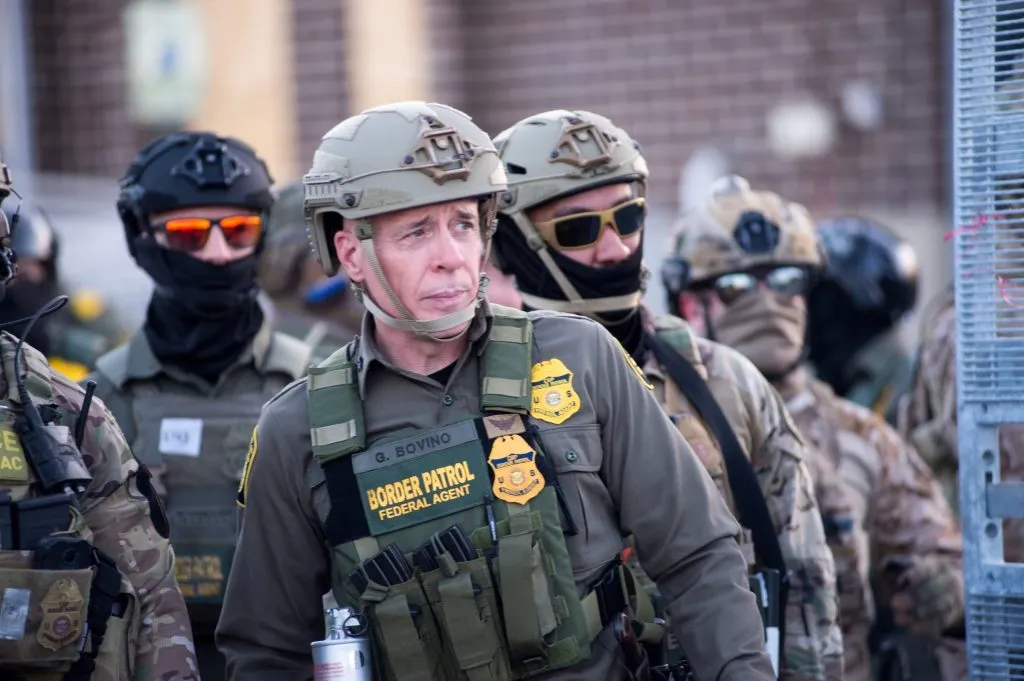
Within the Border Patrol, “there’s such a large, large gap between that kind of warrior mentality and that kind of, you know, ‘the public is dangerous and our life is on the line here,’ and what they actually do day to day, which is process people who exist on a spectrum of displacement,” Vega said.
Still, there can be moments of extreme stress. “I think that people don’t quite realize how hard the day to day of those jobs can be, especially in those key moments of surges where people are, working very long hours sometimes in a very chaotic, difficult situation and trying to manage a tense humanitarian and security challenge,” said Herman, citing past surges of migrants at the border. “But I also think that the American people have every right to expect a level of professionalism and resourcefulness and adaptability as the situation at the border changes.”
And Vega said this lack of understanding by the public is why Border Patrol and its union have often pushed back against criticisms that they use excessive force.
“When people are outsiders to their profession and to their organization, they sort of lack legitimacy in the eyes of Border Patrol agents and other law enforcement officers to kind of critique their work,” Vega said.
Yet it’s not clear if there has been sufficient accountability even when CBP has found problems — and CBP rarely finds agents go too far. This is reflected in the texts between agents that were obtained in the Santiago case, saying he would get a “slap on the wrist,” and that the “reasonableness” argument would be different if he were in the field because there are “mitigating circumstances.”
CBP’s local review boards, which examine agency use-of-force incidents that don’t result in death or serious injury, determined only 3.2% of roughly 3,000 cases nationwide in fiscal years 2021 and 2022 were potentially policy violations. Since 2020, in the few cases other than Santiago’s where Ajo Station agents were found to have used force in violation of agency policy, discipline was light to nonexistent. Agency data shows at least three other instances where CBP local review boards found excessive use of force at Ajo. In two of those Ajo cases there was no discipline, and the third only led to verbal counseling.
“What they’ve been allowed to get away with in the past sort of set the benchmark for what’s appropriate,” said Christy Lopez, a former Obama-era Justice Department official who reviewed alleged abuses by police departments.
Lopez, now a Georgetown University law professor and co-director of its Center for Innovations in Community Safety, referenced the deployment of Border Patrol agents to U.S. cities over the last year and many of those agents’ aggressive, often violent tactics on U.S. citizens and immigrants that have been caught on video. She said the agency’s track record of lax accountability is “one of the reasons why it’s been able to get so bad so quickly.”
“No one has ever been holding their feet to the fire the way that they probably should have been,” Lopez said.
Published with The Project on Government Oversight

IRW has worked closely with the team at POGO since mid-2025 to produce in-depth journalism.