(Illustration by Ren Velez / POGO)
DHS assault cases spiked to a record high. Experts and judges have raised alarms.
Federal data shows a surge in DHS alleging its agents have been assaulted or impeded. Although many cases have collapsed in court, some fear the risks to constitutional rights.
February 24, 2026
From Minneapolis to San Antonio, DC to Los Angeles, the Department of Homeland Security (DHS) has been quick to claim that people have assaulted or impeded its agents.
In fiscal year 2025, DHS sent a record number of referrals to federal prosecutors proposing charges under 18 U.S.C. 111, according to previously unreported data analyzed by POGO Investigates, the news reporting division of the Project On Government Oversight, and the Investigative Reporting Workshop (IRW). In the federal criminal code, Section 111 makes it illegal for anyone who “forcibly assaults, resists, opposes, impedes, intimidates or interferes” with federal law enforcement agents, or former agents, while they are engaged in or because of their official duties.
POGO and IRW’s review sheds new light on the extent of DHS’s role in driving a wave of alleged assault and interference prosecutions. At least two dozen of these claims that have gone to court were later dismissed by prosecutors, resulted in not-guilty verdicts, or were even rejected by grand juries, as federal data and previous in-depth examinations have shown.
Federal prosecutors received 274 formal referrals from DHS in fiscal year 2025 where Section 111 was the lead charge, according to the government data, which was obtained by the Transactional Records Access Clearinghouse.
That’s the highest in any year since the department was created. It’s about twice as high as the next highest, fiscal year 2019.
A notable increase began in late February 2025, with about 77% of fiscal year 2025’s referrals occurring in its last six months, ending on September 30. Several factors could have influenced this increase, including the higher number of agents on patrol in the streets as part of DHS’s nationwide immigration enforcement operations and the protests stemming from agents’ presence in cities across the country.
In a written statement to POGO and IRW, a DHS spokesperson attributed the spike to increased violence against its agents.
“It should come as no surprise that there’s an increase in referrals under 18 U.S.C. 111 as there’s been a massive increase in violence and threats against federal law enforcement,” the spokesperson said. “ICE officers are facing a 1300% increase in assaults, a 3200% increase in vehicle attacks and an 8000% increase in death threats against them.” (Publicly available data does not appear to back up DHS’s statistical claims about assault.)
“There are myriad factors that affect the outcome of any given prosecution,” the DHS spokesperson said, regarding why there are dozens of cases resulting in dismissals or not guilty verdicts, adding that “the fact remains that anyone who assaults one of our officers is committing a felony, and anyone who obstructs them is committing a federal crime.”
DHS referred POGO and IRW to the Justice Department for questions on specific cases. A Justice Department spokesperson did not respond to questions about the cases and the broader surge. Stephen Miller, White House deputy chief of staff and homeland security advisor, recently posted on X that the failure of cases in Los Angeles are the result of “Mass judge and jury nullification, deep in blue territory, of slam-dunk assault cases against federal law enforcement.”
DHS encompasses several law enforcement components, but the lion’s share of DHS referrals has come from ICE. Out of all DHS referrals where Section 111 is the lead charge, ICE was the source of 126, up from 28 in fiscal year 2024, according to the Justice Department data.
Out of all DHS referrals where Section 111 is the lead charge, ICE was the source of 126, up from 28 in fiscal year 2024, according to the Justice Department data.
This surge isn’t going unnoticed. In a December presentation, the National Lawyers Guild, which trains activists and legal observers, called Section 111 “the Government’s Offense of Choice” to silence dissent toward its immigration operations.
The spike in cases from the last half of fiscal year 2025 is just the beginning.
In the last days of the fiscal year, Trump administration officials put pressure on agencies to prosecute these cases. On September 25, the White House issued National Security Presidential Memorandum-7, which cites Section 111. It directs DHS, the Justice Department, and two other departments to be expansive in the investigations and prosecutions of people who interfere with ICE, citing “terroristic conspiracies” and “organized political violence.” On September 29, Attorney General Pam Bondi directed prosecutors to prioritize charging people interfering with ICE operations under Section 111.
Citing the resignations of prosecutors, like those in Minnesota reportedly under pressure to charge protestors with assault before adequate evidence has been collected, former Justice Department ethics attorney Jesselyn Radack said she believes prosecutors are being pressed to prosecute cases they have problems with. In some of those, Radack says it is likely they “are being overridden by superiors who are under greater institutional political pressure.”
“Prosecutors who are weaponizing the justice system are prioritizing their fealty to the president over their bar licenses — and more significantly, over the oath they took to protect and defend the Constitution,” commented Radack.
Experts say prosecuting cases that lack merit puts people’s rights at risk, including their First Amendment rights to monitor government actions and protest, and can wrongly force people to defend charges that should not have been brought.
“We’re seeing a systematic policy directed against civilians to stop them from observing government activity, which is unconstitutional,” said David Bier, an immigration policy expert with the Cato Institute, who focused on impacts on First Amendment rights in a recent post. “It’s a threat to the rights of every American.”
Unsubstantiated charges can also undermine the rights of immigrants.
We’re seeing a systematic policy directed against civilians to stop them from observing government activity, which is unconstitutional.
— David Bier, immigration policy expert with the Cato Institute
In one assault case in Texas where a judge said that an ICE agent’s injury was “self-inflicted” and another engaged in “blatant misstatements,” the judge wrote that charges can be used by the government to short-circuit the due process rights of undocumented immigrants with no prior criminal histories to arrest them without warrants. Allowing dubious charges to stand in for immigration arrest warrants would tempt agents, “under the pressure of ever-increasing quotas, to cut constitutional corners,” the judge wrote.
That’s not the only case where the accuracy of DHS agents’ claims has been in question.
In January, DHS claimed in a press release that Julio Cesar Sosa-Celis and two others resisted and violently assaulted an ICE agent in Minneapolis, leading the agent to shoot Sosa-Celis in the leg. Sosa-Celis and another person were charged under Section 111, and for aiding and abetting each other’s alleged assault and interference of the ICE agent.
Yet, earlier this month, prosecutors moved to dismiss the case, writing that “newly discovered evidence in this matter is materially inconsistent” with claims made to justify bringing the charges.
“A joint review by ICE and the Department of Justice (DOJ) of video evidence has revealed that sworn testimony provided by two separate officers appears to have made untruthful statements,” acting ICE Director Todd Lyons said in a February 13 statement. “Both officers have been immediately placed on administrative leave pending the completion of a thorough internal investigation. … The U.S. Attorney’s Office is actively investigating these false statements.”
An “Unusual” Approach to Section 111
Experts have seen changes in how the government is using Section 111, namely in its use of the statute against protestors. Bier, who is a former Republican congressional staffer, said Trump administration officials are using Section 111 anytime they want to justify the arrest of someone who is legally inside the United States.
The statute is designed to prosecute physical or forceful interference with a law enforcement operation, he said, but now officials are charging people who protest, yell at, or record agents — actions they would have ignored under another administration.
“This is unusual to have so many cases where people are being charged with crimes for resisting arrest and for impeding law enforcement, where there’s no underlying crime that they’re accused of,” Bier said.
“Force is an essential element” in violating Section 111, according to the Justice Department’s Criminal Resource Manual, which Bier cited in his December 15 post on constitutional concerns surrounding the Trump administration’s use of the statute. Depending on the facts of the case, if convicted of a Section 111 charge, sentences can vary from less than a year to up to 20 years. Some of the cases brought over the last year seemingly meet the force standard, leading to guilty verdicts or defendants pleading guilty. Some are still pending, such as the felony charge brought against Walter Leonel Perez Rodriguez, who ICE accuses of assaulting an ICE agent with a metal cup filled with hot coffee, “causing a laceration to the officer’s lip resulting in 13 stitches and burns to the side of his face.” Rodriguez has pleaded not guilty.
This is unusual to have so many cases where people are being charged with crimes for resisting arrest and for impeding law enforcement, where there’s no underlying crime that they’re accused of.
— David Bier, immigration policy expert with the Cato Institute
But under this administration, agents and prosecutors have used an expansive definition of assaulting and impeding law enforcement.
“The arrests that we’ve seen usually involve some further complication or some further action on the part of the person following them,” Bier said. “But, you know, it’s things like blowing a whistle, yelling, honking, which are all protected as well by the First Amendment.”
One case out of Washington, DC, created one of the leading symbols of the city’s protests against the National Guard deployment and immigration-related arrests.
On August 10, Sean Dunn yelled at CBP agents, calling them “racists” and “fascists.” Dunn then threw a footlong Subway sandwich at agent Greg Lairmore before running away and ultimately getting arrested. He was released, but three days later, 20 federal agents re-arrested him at his apartment, according to Dunn’s defense attorney. The White House posted online an edited video of that arrest.
“If you lay a hand on a law enforcement officer, be certain we will come after you with the full weight of the law,” said Jeanine Pirro, U.S. attorney for the District of Columbia, in a statement about Dunn. “This alleged assault is no joke – it’s a serious crime, and those who think otherwise will learn just how gravely mistaken they are.”
Federal prosecutors sought a felony indictment for assault from a grand jury and failed. Prosecutors then charged Dunn with a misdemeanor assault charge, which does not require a grand jury’s approval. His case went to trial and a jury acquitted Dunn, who said he threw the sandwich in protest.
“Most experts (and the jury) seemed to agree that he was overcharged for ordinary protesting activity against Trump’s deployment of National Guard troops to DC’s streets,” Radack, the former DOJ ethics attorney, told POGO and IRW. (Radack knows Dunn because he is a friend of one of her clients.)
In a Los Angeles-area case, federal prosecutors brought a misdemeanor charge of assault against protestor Brayan Ramos-Brito after, as with Dunn, they initially sought to bring a felony charge against him. The charges alleged he struck Border Patrol agent Jonathan Morales during a protest outside of a Homeland Security Investigations office complex. An affidavit alleges Ramos-Brito blocked the agent while he was pursuing another protestor.
The case involved testimony from Greg Bovino, the Border Patrol sector chief recently removed from command in Minneapolis who had also led operations in Los Angeles, Chicago, and North Carolina over the last year. Bovino alleged in court that he saw Ramos-Brito hit Morales in the chest.
During the trial, several videos failed to show Ramos-Brito hitting the agent, although they did show Morales shoving Ramos-Brito.
Ramos-Brito’s defense attorney accused Morales of lying and Bovino of “trying to cover up for him.” A jury acquitted Ramos-Brito.
Charging Before Evidence
The wave of DHS referrals for alleged assaults and interference comes as many DHS agents have been documented using force, including fatally shooting at least five people since September, according to Trace’s tracking of shootings by ICE and Border Patrol agents. Out of some of those cases have come quick, public allegations released by DHS before prosecutors have properly examined available evidence.
In the shootings of Renee Good and Alex Pretti, DHS officials quickly claimed that the two Minneapolis residents were trying to attack agents in the moments before they were killed. Within hours of the shooting, DHS Secretary Kristi Noem said Good engaged in “an act of domestic terrorism” by allegedly trying to hit an agent with her SUV despite video appearing to show her turning the car away from agents. Noem also said Pretti “committed an act of domestic terrorism,” although video contradicted that claim and she later said she may have been wrong. “We were being relayed information from on the ground from CBP agents and officers that were there,” she said.
Law enforcement agents often defend their use of force by saying they have to make extremely hard split-second decisions in stressful situations where they or others could be at risk if they hesitate, and their actions therefore can’t be judged with the benefit of hindsight or more information than the agents had in the moment.
Meanwhile, in some Section 111 cases, agents have sometimes alleged greater force used against them than evidence can show. Court documents and outside evidence in a string of cases reveal that defendants’ accounts of the incident have differed starkly from agents’, particularly when officials blame civilians for initiating or escalating force.
In Chicago, Border Patrol agents charged Marimar Martinez and Anthony Ian Santos Ruiz under Section 111 after alleging in an affidavit that Martinez sideswiped CBP’s silver Chevy Tahoe while Ruiz hit the vehicle from behind on October 4, 2025.
After agents exited their vehicle, and as Martinez drove at an agent before fleeing, one of the agents shot at Martinez’s car five times, according to the complaint. Paramedics met Martinez at a repair shop about a mile away and took her to the hospital to treat her for gunshot wounds.
Prosecutors charged Martinez and Ruiz with assaulting a federal officer with a deadly and dangerous weapon. But less than two months after filing charges, they filed a motion to dismiss the case against both of them.
Martinez recounted the incident much differently. Christopher Parente, Martinez’s attorney, told POGO and IRW that Martinez was following the agents and beeping her horn to warn the local community that ICE was in the neighborhood when the incident took place. The driver of the Border Patrol vehicle swerved into her, not the other way around, Parente said, at which point Martinez slammed on her breaks.
Body camera footage released earlier this month appears to show the agent swerving toward Martinez. Within six seconds of the collision, the gunshots can be heard. Text messages between agents indicate that, in the wake of the shooting, DHS leaders were supportive of the agent: “Everyone has been including Chief Bovino, Chief Banks, Sec Noem and El Jefe himself… according to Bovino.” (The Chicago Tribune speculated that “El Jefe,” meaning boss, could reference Trump.)
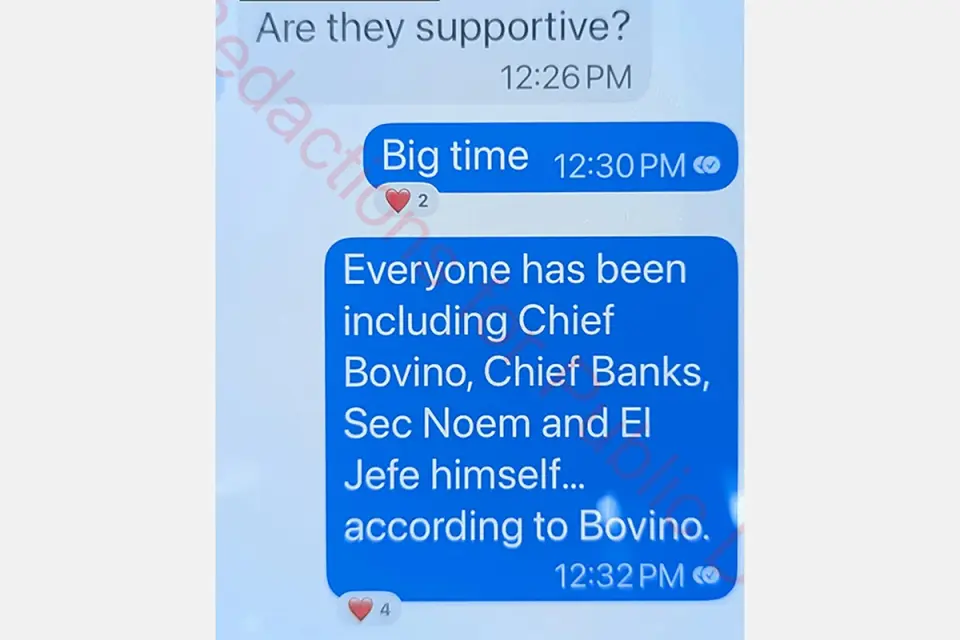
In his time as a defense attorney, Parente said he hasn’t seen a case where the government’s account is as different from the defense’s as in the Martinez case. He said video evidence supports Martinez’s perspective and undermines the agents’ credibility, which is why he thinks prosecutors moved to dismiss the case before trial.
“It’s part of this new mindset of charging cases before you’re done with the investigation,” Parente said.
In Charlotte, North Carolina, Border Patrol agents alleged that a United States citizen named Cristobal Maltos followed them in a black Honda Civic. When they noticed for a second time that Maltos was following them, they blocked him in with three vehicles, according to an affidavit by an FBI investigator.
Border Patrol agents surrounded his car. After one agent leaned over the Civic’s hood, officials alleged that Maltos moved forward around 30 feet, hitting a second agent with the car’s side mirror.
Prosecutors charged Maltos with a felony under Section 111 for assaulting, resisting, and impeding an officer.
A bystander’s video of the arrest contradicts officials’ account. Maltos’ Civic can be seen swerving roughly a few feet forward at the time the affidavit alleges he assaulted an agent, but not the 30 feet officials claimed. Jake Sussman, Maltos’ civil attorney, told POGO and IRW that Maltos’ foot left the car’s clutch when agents surrounded him, causing the car to jostle. And, according to a recording of a 911 call he placed during the incident, Maltos said that agents hit his car with their vehicle before arresting him, a fact that officials excluded from their account.
Sussman, who took on his case after prosecutors dismissed the charges, said agents had no legal basis for stopping Maltos to begin with. In the investigator’s affidavit, there was nothing alleging that Maltos was committing a crime that would have justified agents stopping him, he said. The affidavit says that agents believed Maltos was following them, which Sussman said was not impeding agents’ operations.
Two weeks after Maltos’ arrest, prosecutors moved to dismiss the case.
The effects of these Section 111 allegations don’t stay inside the courtroom when a case is dismissed.
Sussman said Maltos’ arrest was scarring to him — he was terrified and injured — and his association with the allegations remains. And even though prosecutors dropped the charges, Parente said Martinez now has to live with DHS’s side of the story, which the department pushed in statements on social media and in a press release calling her a “domestic terrorist,” as part of her permanent public image.
“That stays out there, right?” Parente said. “There’s no, there’s no retraction that I’ve seen yet.”
Pushback from the Bench
Judges have cast doubt on the validity of some of the cases prosecuted among the wave of DHS’s Section 111 referrals, criticizing federal prosecutors’ approach to ushering them through the courts and the number of cases they’ve ultimately had to dismiss.
One judge’s criticism came after a series of arrests of protestors at an ICE detention center in Broadview, Illinois, on September 27 of last year brought several cases into his courtroom.
Magistrate Judge Gabriel Fuentes issued his November 20 opinion at the close of a case against 70-year-old Dana Briggs, an Air Force veteran. Briggs was one of four people from the Broadview protests charged with felony violations under Section 111 whose charges were dismissed within two months. Prosecutors charged a fifth with a misdemeanor in a case that was also dismissed.
Fuentes called it “possibly unprecedented” for the United States Attorney’s Office in his district to charge people “so hastily” that they weren’t able to obtain indictments or had to dismiss because of insufficient evidence. In prosecuting Briggs, he wrote that prosecutors “swung and missed” multiple times.
The typical order of criminal prosecutions doesn’t include dismissing unsupportable or unfair charges that the government had sworn were supportable, he wrote.
According to Fuentes, grand juries in Illinois’ Northern District hadn’t declined to indict people whom prosecutors sought charges against since “the early part of this century.” But the charges DHS filed during the agency’s Operation Midway Blitz in the Chicago area resulted in three “no bills” from grand juries, meaning they declined to issue an indictment when federal prosecutors sought one.
“Any responsible federal prosecutor knows that federal charges, or any actions by the United States Attorney directed at the citizenry, must be undertaken with the utmost care,” Fuentes wrote.
Other judges have pushed back against prosecutors’ use of Section 111 in cases involving other law enforcement agencies and National Guard troops patrolling with DHS agents.
In an October 3, 2025, order, Magistrate Judge Zia Faruqui of the District Court for the District of Columbia wrote that the prosecution of two Washington residents under Section 111 was an example of “recent unprecedented prosecutorial action.”
Any responsible federal prosecutor knows that federal charges, or any actions by the United States Attorney directed at the citizenry, must be undertaken with the utmost care.
— Magistrate Judge Gabriel Fuentes
Prosecutors charged both residents with felony violations of Section 111 before dismissing and reducing them to misdemeanor violations. They dismissed the charges again. Finally, prosecutors again brought charges against one of the residents, Terrance Wilson, only to dismiss them for a third time.
“This roller coaster is anything but normal,” Faruqui wrote. “And the consequences of which will haunt Mr. Wilson and Ms. Butler. They were detained for days, strip searched multiple times, have arrests on their records, and Mr. Wilson is still subject to charges in Superior Court.”
In his opinion, Fuentes, too, had referenced the burdens placed on defendants defending against federal charges. Defendants serve some period of detention time and need to retain legal counsel, prepare for and appear in court, Fuentes wrote. Briggs spent almost two days in detention after his arrest. Butler and Wilson were detained for nearly four.
Faruqui pointed to a larger trend of dismissals overshadowing the prosecution of those Washington residents. Out of over 4,000 cases charged by complaint between 2014 and 2024, prosecutors moved to dismiss less than 20 cases, according to Faruqui’s order. In the two months leading up to the order, prosecutors moved to dismiss 20 out of the 95 cases they charged by complaint in Washington. Most of the 20 were Section 111 cases.
“Manufacturing a felony”
Some of the Section 111 cases involve agents using harsh tactics against people suspected of being immigrants in the U.S. without legal authorization. In some of those cases, there have been allegations of excessive use of force by the agents. One case is that of Javier Ramirez — a U.S. citizen.
Ramirez was charged under Section 111 after Border Patrol agents pursued him from the L.A.-area car lot where he worked. In an affidavit, an ICE agent wrote that Ramirez ran into an agent on June 12 as he fled, causing their phone to fall to the ground. Ramirez refused to answer questions, the affidavit alleges, and when one agent tried to handcuff him, Ramirez pulled away, then pushed an agent. When agents restrained Ramirez on the ground, he bit one of them, according to the affidavit.
In a statement he gave lawmakers, Ramirez said “fear gripped” him when the masked, armed agents appeared. After speaking to one of the agents in Spanish, Ramirez said he heard one agent say, “Get him, he’s Mexican.” He said he was grabbed and thrown to the ground.
“The first agent then put his knee on me, close to my mouth, as I was facing down with my head to the side, and I heard my jaw crack. I yelled in pain,” Ramirez recounted in a court declaration. “I tried to move my head because I remembered how a police officer killed George Floyd; I did not want to die.”
Ramirez’s lawyer has denied Ramirez assaulted an agent.
While security footage does not show their initial interactions or show Ramirez assaulting agents, it does show two agents aggressively handcuffing Ramirez on the ground as he moves around.
Based on the agent’s affidavit, Ramirez was charged with assault on June 13, the day after the encounter and after he was already placed in detention, where he would stay for several days. About three weeks later, in July, prosecutors dismissed the charges.
Another case raised the displeasure of a judge who called the government’s conduct “outrageous.”
In San Antonio, Texas, on the morning of June 20, ICE agents launched what U.S. District Judge Xavier Rodriguez would call a “warrantless arrest” because the ICE agent leading the case had not yet documented any evidence that ICE could legally deport Jaime Alberto Quintanilla-Chavez.
After staking out his house in the morning, agents pulled Quintanilla-Chavez over in his truck as he was driving to work. The agents recounted that Quintanilla-Chavez would not roll down his window as commanded, that he was using his phone, and that he held up a Honduran identification card.
One ICE agent, William Carl, smashed Quintanilla-Chavez’s window as his truck moved forward, and then slowly backed up, finally stopping when the trailer connected to his truck allegedly hit another agent’s vehicle. Carl opened the vehicle door and forcefully removed Quintanilla-Chavez.
“Bleeding from the head and painfully handcuffed, the Defendant attempted to speak to officers in his native Spanish, but SA [Special Agent] Carl told him to ‘Shut your f_______ mouth. Shut your mouth,’” the judge wrote.
Only then did the other ICE agent ask Quintanilla-Chavez about his immigration status.
Prosecutors charged Quintanilla-Chavez with assaulting an agent because Carl scraped his arm when he punched through the driver’s side window to unlock the truck door, and his arm got “caught on the broken window glass.”
Rodriguez would dismiss the indictment because he found Quintanilla-Chavez did not forcibly interfere, obstruct, or assault the ICE agents. The agent’s decision to smash the car window did not, according to the judge, mean Quintanilla-Chavez had acted forcefully toward the agent.
Judge Rodriguez also questioned the government’s motive for bringing the assault charge. Normally, ICE needs a warrant to arrest someone unless there’s a basis for charging them with a felony. In Quintanilla-Chavez’s case, Rodriguez wrote in his October 20 order that the government was “manufacturing a felony” with the assault charge to skirt the fact they had no warrant.
“His indictment under 18 U.S.C. § 111(a) represents the rare case in which the Government’s conduct is so ‘shocking to the universal sense of justice’ that it should be deprived of the opportunity to prosecute the Defendant,” Rodriguez wrote.
Published with The Project on Government Oversight

IRW has worked closely with the team at POGO since mid-2025 to produce in-depth journalism.